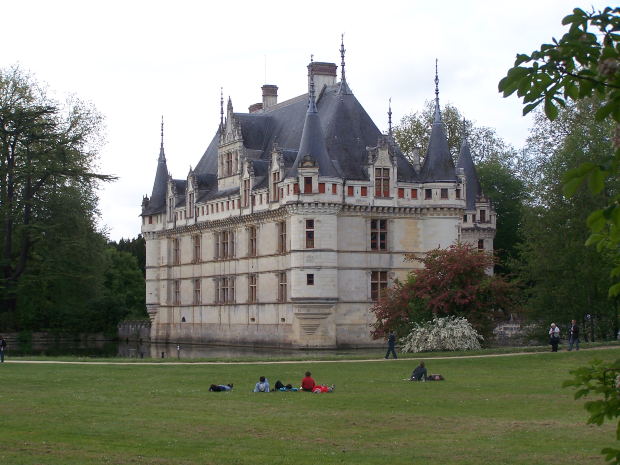
11th Century Cluny Abbey- Provence River Cruise

Take A Provence River Cruise To Cluny Abbey

Provence River CruiseCluny Abbey is a Benedictine monastery in Cluny, France. Built in the 11th Century and nearly destroyed during the French Revolution, it is one of the most significant abbeys of the Middle Ages. The three churches at Cluny Abbey were built in succession from the 10th to the early 12th centuries.

Cluny Abbey was one of the most important Benedictine, Christian monasteries of its time, helping to bring stability to the European society. It was the center of a major monastic movement of the Middle Ages that would spread throughout Europe.

The land for the abbey was donated by William I the Pious, Duke of Aquitaine and Count of Auvergne, from his own forested hunting preserve.

The Cluny Abbey was founded by Benedictine monks with a keen desire to observe closer adherence to the Benedictine rule. A distinctive aspect of their spirituality was their commitment to offer eternal prayer, emphasizing liturgy and spiritual pursuits over labor and other monastic activities.

Though some religious orders traditionally led a frugal life in that period, the case was different with the monks at Cluny Abbey. There were solid gold and silver chalices with gems for the Mass. Though monks usually ate porridge and broth, the monks at Cluny Abbey enjoyed wine, cheese and roasted chicken. They wore rich clothes made of silk and linen for the Mass.

A substantial part of the Cluny Abbey was designed with Romanesque architecture. It once housed Romanesque sculptures that are considered to be masterpieces today. Not only this, the library in Cluny Abbey was once considered to be the most important and the richest library across all of Europe. It held many important and valuable books. The Cluny Abbey stood as a great symbol of French culture in its time.

The church of the abbey was the largest Christian building in the world, until St. Peter’s Basilica was rebuilt in Rome in the 16th century.
What is left of Cluny Abbey today is a small portion of the third church and the bell tower, along with the 15th-century abbots’ residences and 18th-century convent buildings. The site also includes pleasant gardens and a museum with Romanesque artifacts.

Provence River Cruise And The Historical Abbey of Cluny

Our Provence river cruise offers a visit to the historical Abbey of Cluny. Contact us for more information! Europeanbarging 888-869-7907

The Charming Village of Le Baux de Provence- Rhone River Cruise

Rhone River CruiseThis Rhone River Cruise Brings Passengers To The Village of Le Baux De Provence

Le Baux de Provence is an exceptionally picturesque village, more famous as a tourist site than being an active village. And with the surrounding Alpilles, it is extremely beautiful.

When you arrive at the village, you are astonished by the out-and-out scale, not only of the surrounding countryside but of the village itself. Les Baux de Provence was, and still is, more like a strong, fearsome stronghold than a pretty little village. In 1998, it was added to the elite official category of “The Most Beautiful Villages of France”.

Les Baux de Provence indeed remains a village officially as the population in the inner walled city is only 400. The number shrinks to just 22 in the winter months. Nevertheless, the dimensions of the buildings – the Château and its massive keep, the opulent Saint Vincent’s Church and grandiose Renaissance private mansions – are a testimony to Les Baux’ former wealth and power.

The village had an exceptional royal history. Though between the 17th and 19th centuries, it was almost a discarded and deserted place. It was only after the discovery of the mineral bauxite (the name is derived from “Les Baux”) in the neighboring hills that life came back to the village. The tourists started visiting the place and have more recently transformed it. Today, the number of visitors exceeds 1.5 million each year.

The tourists usually flock to the village during the day with the crowd thing rapidly after around 5 p.m. or so, depending on the season. So, it will be great to turn up rather late and enjoy the splendid castle in relative peace. The cultural heritage of Les Baux is exceptionally rich, with 22 architectural treasures classified as “Historic Monuments”, including the church, chateau, town hall, hospital, chapels, houses, doorways and such, without counting items of furniture and a collection of paintings.

You can visit the village only by foot and will admire the ancient houses that have been carefully restored, beautiful Renaissance facades and several magnificent “hotels particulars”, which presently serve as art galleries or museums. There is a winding steep road up to the town and the street of the town are steep as well.

While moving around the village, you will discover many craft shops selling Provençal products and souvenirs. Food lovers will be particularly happy to discover that several restaurants at Les Baux boast international reputations. Indeed, such quality dining is so hard to resist!

The Rhone River Excursion Is One To Remember

Les Baux de Provence is often offered as an excursion from Provence barge and Rhone River cruises. Contact us for more information! Europeanbarging 888-869-7907

The Pilgrimage Site of Vézelay- Meanderer Barge Cruise

Meanderer Barge- The Pilgrimage Site of Vezelay

Meanderer Barge CruiseVezelay is a small town in the Burgundy region of France. This hill town is one of the most visited pilgrimage sites from the Medieval Age. It is located in an area of prominent pre-Christian sanctity. Though there is no information about the date of the original settlement of the town, its Les Fontaines Salées mineral springs have been favored for their therapeutic qualities since at least the 3rd millennium BC. Celtic presence is evident from the sixth century B.C., and Romans had constructed temples and thermal baths by the second century B.C.

The village of Vezelay was one of Europe’s most sacred places In the Middle Ages. Somewhere near 1050, local monks claimed they had acquired the miracle-working bones of St. Mary Magdalene. The announcement had such a fast and strong effect that, overnight, pilgrims from across Europe flocked to Vezelay to pray at St. Mary’s shrine. Vezelay obviously reaped huge benefits from the sudden influx of pilgrims who brought plenty of money.

Presently, Vezelay is visited by hundred of pilgrims desiring to pray at the Basilica of St. Mary Magdalene, and that number is increasing every year. This Basilica is one of the most magnificent masterpieces of Burgundian Romanesque art and architecture in France. It was listed on the United Nations Educational, Scientific and Cultural Organization’s (UNESCO) World Heritage Sites in 1979. The site is also called Vézelay Abbey, Basilique Ste. Madeleine, La Madeleine, Basilique de Vézelay, and Vézelay Basilica.

The dominant Basilica, to which all paths lead, is situated on the highest point of the city. It is a great monument to piety, where St. Mary’s relics are held in a darkened underground crypt honed from the rock. These are not the original relics that pulled thousands of Medieval pilgrims to Vézelay, as those were burned by French Calvinists during the 16th century Wars of Religion. The present relics were given in 1876 by the Archbishop of Sens. These relics were actually a gift from Pope Martin IV to the Diocese of Sens in 1281.

In addition to being the holy home of St. Mary’s relics, Vezelay was also witness to the launch of the Second and Third Crusades.

Six Passenger Meanderer Barge Cruise

Our six-passenger meanderer barge cruise offers an excursion to Vezelay on its Upper Loire Valley itineraries. Contact us for more details! Europeanbarging 888-869-7907

The Dutch Windmills of Kinderdijk

The Dutch WindmillsThe Dutch Windmills of Kinderdijk On The Holland Barge Cruise

Kinderdijk is a village in the province of South Holland in the Netherlands. It is situated in a low lying area at the conflux of the Lek and Noord rivers. Around 1740, a system of 19 windmills was created in order to drain the polder (a tract of land surrounded by dikes). This particular group of windmills is the largest concentration of old windmills in the Netherlands.

The windmills of Kinderdijk are one of the most renowned Dutch tourist sites. They have been listed on the United Nations Educational, Scientific and Cultural Organization’s (UNESCO) World Heritage Sites since 1997.

A traditional windmill (called windmolen) is possibly the most exemplary Dutch symbol. As you travel about the Netherlands, you can find usually one or probably two Dutch windmills dispersed in the landscape, set apart in the fields. However, you can seldom find the great sails moving, as many are no longer operational. It’s sad but true that there are only about a thousand or so windmills left in the entire country. A source claims there are about 1,150 windmills left, but the fact is that the Dutch will only “count” a windmill if it is fully operational. So, the display of several spectacular windmills, sails rotating in the wind, such as these at Kinderdijk, is indeed a sight to enthrall a tourist’s heart.

For centuries, the use of windmills to pump out excess groundwater, dikes, sluices and canals has been part of the Dutch culture and survival. The 19 remaining windmills at Kinderdijk are actually still operational, although now modern technology does most of the pumping and land reclamation throughout the modern Netherlands. But the fact remains that, for centuries, the windmills played an important role in pumping water from the polders into the canals from ground water overloads, flood waters, and, in the area nearest to the North Sea, high tide waters.

Take A Holland Barge Cruise to The Dutch Windmills

Though Kinderdijk is particularly famous for its windmills, it is also a recreational area, drawing many hikers and bikers to the miles of paths topping the hundreds of dikes in this great polder.

Our Holland Barge Cruises and Holland Tulip River Cruises offer excursions to Kinderdijk. Call us for more information about these cruises and book one of them to see the spectacular beauty of the windmills at Kinderdijk! Europeanbarging 888-869-7907

Chateau De Rully In Burgundy France: Visit the Medieval Castle

CastleExplore France in Another Light- Chateau de Rully

Chateau de Rully is a medieval fortress situated in the midst of vineyards in the commune of Rully, Saône-et-Loire département of France. The castle comes under the Burgundy region of eastern France. It stands on the side of a hill and dominates the whole region, facing the plain leading to the Saône. In the west, it commands the valley towards Nantoux and Chassey-le-Camp.

The castle was built around a 12th century square keep (i.e. Donjon), the oldest part of the chateau that remains. It shows some interesting features of medieval military architecture with its parapet walk, battlements, machicoulis and loopholes.

The present look of the castle was designed in the 15th century with the addition of a small courtyard and north and east wings, turning the fortress into a manor house. Outbuildings and the great and lower courtyards were added in the 18th century. An 18th century building takes pride as Burgundy’s largest stone roof.

Medieval Castle Is An Historical Monument in France

The castle is listed as a historical monument on the supplementary inventory of the French Ministry of Culture and is open to the visitors. Your visit to the castle will take you on a journey through French history from the Middle Ages to today.

Since the castle came into existence, it has been kept in the same family. The current owner will nicely guide you through his home, showing the history of his ancestors. The fact that the castle is private property and not a museum brings about a unique and authentic experience.

Enjoy Wine Tasting at Chateau Rully in Burgundy France

Your trip to Rully becomes more exciting with wonderful wine tastings. Its vineyards expand up to 32 hectares (approximately 79 acres), of which a third are classified as Premier Cru sites. Rully is known for its red and white Rully wines made from Pinot Noir and Chardonnay, respectively. Around two-thirds of the production consists of white wine, and around one-third is red.

Our France barge cruise is a perfect option for you to visit the Chateau de Rully and indulge in some excellent wine tastings, as well as touring this Medieval castle. Call us for more information about our France barge cruise! Europeanbarging.com 888-869-7907